
The success of a design system doesn’t lie in how consistent it is across screens — it lies in how consistent it feels across minds.” Because no matter how perfect the underlying structure, it is the perception of patterns, clarity, and familiarity that defines the user’s trust.
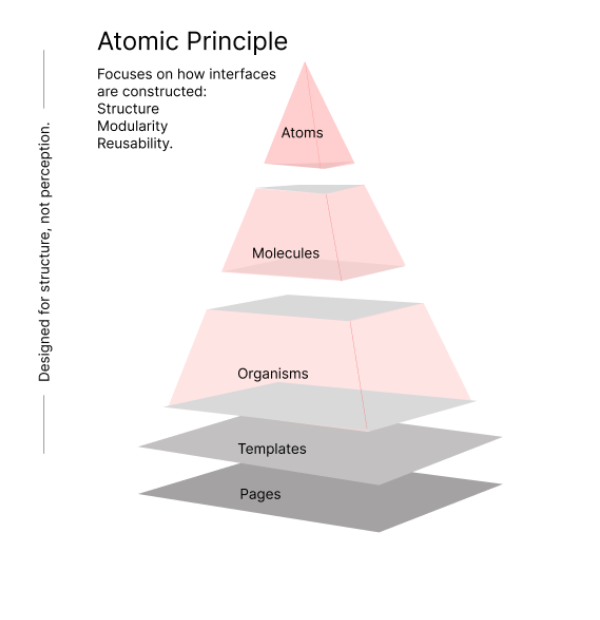
Atomic Design defines the foundational building blocks of any digital experience. From the smallest elements — atoms — to complete pages, this methodology creates a systematic, scalable approach to interface development.
Atoms form the basic UI components, such as buttons, labels, and icons. These atoms combine into molecules, which evolve into organisms, creating more complex and functional sections. Templates define the underlying layout, while pages deliver the final, context-specific experiences.
This framework enables reusability, stability, and alignment with brand guidelines. It empowers teams to design enterprise-level applications efficiently, ensuring consistency and reducing fragmentation across products.
For example, a design token library ensures buttons look and behave identically whether used in search filters, forms, or cards.
2. Gestalt principles
If Atomic Design is the skeleton, Gestalt Principles are the perception that animates it. These are the forces that shape what lies above the water — the part of design users immediately see, connect with, and empathize with.
Gestalt principles define how humans and machines communicate through shared mental models. They orchestrate the schematic, immersive formations that make interfaces feel coherent, familiar, and intuitive for diverse user groups.
Below are five core Gestalt principles and how they influence perception:

- Proximity: Objects close together are perceived as a group.
- Similarity: Similar shapes or colors create a perceived connection.
- Continuity: Flows and sequences are experienced as continuous paths.
- Closure: Incomplete forms are resolved by the mind to appear whole.
- Symmetry: Mirror patterns are perceived as unified shapes.
These principles guide how users instantly make sense of visual groupings, hierarchy, and meaning.These principles guide how users instantly make sense of visual groupings, hierarchy, and meaning.
3. How Gestalt and Atomic Design principles work together in building an effective design system and experience.
Consider an Atomic formation — an organically grown layout assembled from consistent components. This structure ensures clarity and predictability.
Now, integrate Gestalt perception: proximity helps elements feel related, continuity guides the user’s eye along a natural path, similarity reinforces hierarchy and meaning.
When these two frameworks combine, they don’t merely produce interfaces — they generate experiences that are both systematic and emotionally resonant.
Consider an Atomic formation — an organically grown layout assembled from consistent components. This structure ensures clarity and predictability.
Now, integrate Gestalt perception: proximity helps elements feel related, continuity guides the user’s eye along a natural path, similarity reinforces hierarchy and meaning.
When these two frameworks combine, they don’t merely produce interfaces — they generate experiences that are both systematic and emotionally resonant.

Now let us integrate the Gestalt perception into the organically grown template formation from Atomic elements

As UX practitioners, we must understand not only how to build robust, scalable design systems but also how to shape perception — so that humans and machines communicate through intuitive, meaningful experiences.
“When you design, ask yourself: Are you only assembling atoms — or are you crafting perception?”